
1. Include musical instruments in the play environment where children can have free access to them.
2. Celebrate children’s musical activity. Praise them for their musical efforts, don’t just label it as noise. Write down the words to the songs they make up or record them.
3. Offer opportunities to experience many kinds of music (e.g. encourage families to share music and instruments from their culture).
4. Sing and recite poetry and nursery rhymes often. Continue reading
Category Archives: Resources
Inclusion Ideas Corner – Smooth Transitions
Smooth transitions, whether they are big or small, start with consistency and repetition. Here are some ideas:
• Make up a song for each transition sung to familiar tunes. Consistently sing the same song for each transition. This supports the children to make a link between the song and the expectation of the routine.
• During long wait periods, provide a small bin or basket of hand held toys for the children to choose from while they wait their turn. Continue reading
King Koonto and Jeffrey Make Music
My name is Rory the Cook. I feed everybody at Andrew Fleck Child Care Centre, except on Thursdays, when cowgirl Kathleen steps in for me so I can do other things like make music. I write music for choir and for jazz ensembles, I play drums and percussion with a particular interest in spontaneously improvised music and, occasionally, I teach individual lessons and group classes. I have had the pleasure of leading music workshops for kids at the Featherston Autism Unit and likewise for youth with Autism through the SNAP program run by the City of Ottawa. Continue reading
“Parents Helping Parents” Support Group
Walking in My Shoes (WIMS) is a “parents helping parents” support group for families with children who have a developmental or physical disability.
I started this group in 2009 shortly after I retired. Having worked in the developmental services field for over 30 years as a front line worker, I frequently saw the isolation many parents experienced and heard the frustration due to lack of support and understanding of what they were going through. Though many had caring extended families and friends, a common phrase I heard was, “they don’t understand as they’re not in my shoes.” Continue reading
One More Thing! Solutions for Caregivers Facing Overload and Overwhelm
On a Thursday evening back in January, a panel of female caregivers (Savannah Ross, Shannon Parker, Kim McLeod, Catherine Corey and Julie Drury) gathered to offer their stories and wisdom on how they have coped with care giving. The following are their tips.
1. Get up every day, look outside and smile. Put one foot in front of the other and remember to smile throughout the day. Continue reading
Ear-defenders, Rocking Chairs and Fidget Toys…
Helping Children with Sensory Processing Needs
Children, like the preschoolers with Autism Spectrum Disorder that I work with at Thursday’s Child Nursery School, may have difficulty processing sensory information and develop many extreme or repetitive behaviours that interfere with play and learning. Engrossed in how their bodies cope with touch, movement, balance, weight, sight, hearing, and taste, these children may engage in continuous movement, make noise, hide under tables, stare at lights, knock things over, chew things, or press against things. YouTube sensation, Carly Fleischmann, both nonverbal and impacted by Autism, has provided insight to us all by typing articulate and moving explanations of what it is like to have overwhelming sensory needs and how they impact on her behaviour. Continue reading
Sparkle the Dragon
A Project to Teach Empathy and Patience in Young Children
Our educators noticed an increase in behaviours which we felt were indicators of bullying. We heard a lot of teasing about differences and seeing a general lack of respect for each other. There were leaders and followers in the group and the educators needed to find a process which would help the children to understand how they were impacting each other’s lives. Through discussions regarding the “Year of the Water Dragon”, with a focus on empathy and patience, we decided there was enough interest to proceed with the Dragon Project. We observed the children role playing a baby dragon hatching out of its egg and that is how Sparkle was born. Continue reading
Clothing Rituals: Moving from Season to Season
Does your child have difficulty with change of clothing between seasons e.g. moving from boots to shoes, long sleeves to short, coat to just a tee shirt? This can be a common characteristic in children with Autism and those with sensory processing difficulties. It can be the result of tactile sensitivity; the child is particular about the clothes he wears, finds tags and seams itchy or irritating, may not like having his sleeves pushed up and likes only loose or tight clothing, socks and shoes or bare feet. Continue reading
Inclusion Ideas Corner
At the Glen Cairn Co-op Preschool, picture cards are used in daily routines with all the children. After tidy up, some children are given a picture card of “hand washing” to give to the educator in the bathroom. This gives the child a task that helps keep them on track when going to the bathroom to wash their hands. After hand washing the children are given a snack picture card to give to the adult at the snack table. This strategy can be used to support many child care routines. Continue reading
The Bead Counter, it Worked for Us
At the Centre éducatif les petits pinceaux, we had a chance to implement several strategies recommended by the behaviour consultant, Jocelyne Desbiens, from Children’s Integration Support Services (CISS) through the Positive Outcomes Program (POP). We implemented the bead counter strategy to support skill development and positive reinforcement of children.
The Concept
The bead counter is a set of beads strung on a thread which slide freely from top to bottom. Each and every time the child moves a bead, he/she is reminded and praised for the desired behaviour.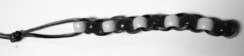 Continue reading
 ACCESS Inclusion Newsletter