
Category Archives: Educators / Providers
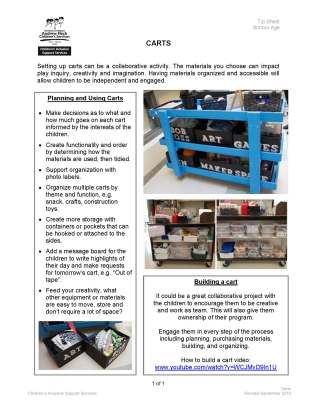
School-Age Tip Sheet: Carts
The Modern Classroom: Are They Really Learning at School?
 Just like everything else in our world, classrooms have evolved quickly in recent years. Where the chalkboard once stood, there is a smart board or projector. Where there once were textbooks, there are chrome books and iPads. Where there once were rows of individual desks facing the front, there are now clumps of desks, standing desks, clipboards and beanbag chairs. The physical components that have changed are just one aspect of the new classroom environment. The modern classroom is different than it was even 10 years ago. Read on to discover an explanation to some of the ways your child’s classroom may have changed since you were in school.
Continue reading
The Benefits of Using Visuals for All Children
ADD or ADHD
 Difficult child, ill-bred child, whimsical child, problem child, lazy child… In short, you’ve probably heard them all before. These are false qualifiers that people attribute to children living with Attention Deficit Disorder with or without Hyperactivity. In our role as Consultants, we meet many of these children in community programs on a regular basis. We try to educate all involved in the face of this disorder, but mainly we try to provide winning strategies to encourage the inclusion of these children to enable them to reach achievable goals. Continue reading
Yoga, Meditation and Mindfulness – The Benefits for children

Pairing a hyperactive child with a quiet, slow form of exercise, may sound counterintuitive and even disastrous, but it turns out yoga can be incredibly helpful for children with challenging behaviours or special needs. Mindfulness is also good for children as it can help them improve their ability to pay attention, to calm down when they are upset, and to make meaningful decisions.
Safe and Secure Relationships – Part 3 of 3

Creating Safe and Secure Relationships in early learning environments results in children who are confident and curious to learn, more able to problem solve and have increased levels of frustration tolerance. Safe and Secure Relationships are essential and are the foundation in reducing behavioural challenges in all age groups. When a child is treated with empathy, they gain a sense of belonging that leads to positive relationships and optimal learning. Further, when children are treated with empathy they learn how to be empathetic towards others. Continue reading
Nap Time Bins
 At La Coccinelle au coeur d’Ottawa, we noticed that as the number of non-sleeping children increased in our preschool group, we didn’t have enough quiet activities to go around. Additionally, the children were losing interest in the activities available in the playroom. We then came up with the idea of creating an activity storage bin system specifically for nap time.
These activities are chosen based on the following criteria: they are quiet, easy to understand and don’t include many pieces. Here are some examples: stacking, association, serialization games, special books, writing boards and puzzles. Activities can be as simple as a clipboard with white paper and pencils to bring out the children’s creativity. Possibilities are endless! The activities can help the children develop their cognitive and fine motor skills as well as their ability to play in an autonomous manner. Continue reading
Attachment is the Work of Both the Caregiver and the Child
 What is a secure attachment?
A biologically based (innate) connection children feel to their parent or caregiver on whom they rely to help them feel safe, cared for, and protected. Attachment is the deep and lasting connection that children form with the people they depend on for care and protection. The work of attachment does not belong to the child. It involves caregiver as protector and the child needs to feel confident that the caregiver will protect them. Children form different kinds of attachment (e.g. secure or insecure) depending on how well their needs are met.
Different types of attachment:
- Secure attachment – Caregiver reacts quickly and positively to child’s needs-
- Insecure/Avoidant attachment – Caregiver is Unresponsive, uncaring, dismissive
- Insecure/Ambivalent – Caregiver Responds to child inconsistently
- Insecure/Disorganized – Caregiver is abusive or neglectful; responds in frightening or frightened ways
Safe and Secure Relationships – Part 2 of 3
 Throughout development children strive for belonging, but they cannot mature among peers alone. Throughout development children strive for independence, but they cannot thrive in isolation. As children grow they require the guidance of adult mentors who understand their needs and who can help facilitate peer interactions. By satiating the attachment needs of the child, adults give them the confidence they need to explore and become capable and competent people. Children need to trust that our bond with them is bigger than any problem they can encounter. In this segment we will examine adult attachment versus peer orientation with regard to stages of development. Continue reading
 ACCESS Inclusion Newsletter