
Ingredients:
- 1/2 cup rice flour.
- 1/2 cup cornstarch.
- 1/2 cup salt.
- 2 teaspoons cream of tartar.
- 1 cup water 1 teaspoon cooking oil.
- Food coloring, if desired.

Ingredients:

A Survival Guide to Life with Children Ages 2-7
By Joanna Faber and Julie King
 “A Survival Guide to life with little children!” Could this be true?
I am a mom of a lively 3 year old boy and a Resource Consultant (RC) who supports parents and Early Childhood Educators. I am thankful that I came across this book at our CISS resource library. Not only does it align with the practices used amongst our team of RC’s it also offers an abundance of fun, effective, concrete tools and tips that I couldn’t wait to begin implementing with my son and within my RC role. Continue reading
Visuals are a tool to visually convey messages and ensure they are understood.
The purpose of visuals is: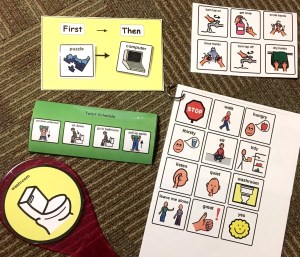
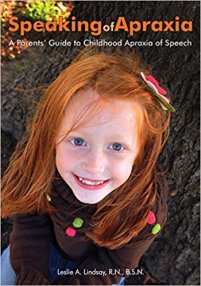 Speaking of Apraxia by Leslie A Lindsay is an easy-to-read comprehensive guide geared towards parents who have a child diagnosed with Apraxia. Apraxia is a motor-speech disorder characterized by difficulty in planning correct speech sounds in the brain and communicating them in the proper sequence to the speech muscles. Written by a parent whose child was diagnosed with Apraxia, this book walks parents through the typical stages of receiving a diagnosis, accessing Speech and Language resources, and transitioning to school. The author uses current research as well as their personal experience to inform the reader without overwhelming them with jargon or professional lingo.
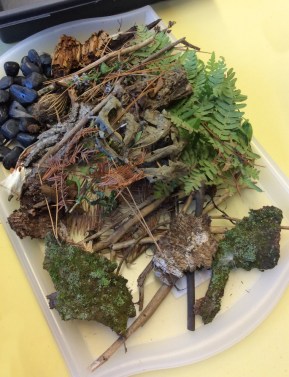 Loose parts provide the foundation for a play-based emergent curriculum that focuses on inquiry driven learning. According to Simon Nicholson, the definition for loose parts states: “In any environment, both the degree of inventiveness and creativity, and the possibility of discovery, are directly proportional to the number and kind of variables in it.”
Nicholson, goes on to state that static, sterile environments such as schools and concrete playgrounds are often devoid of opportunities for curiosity, inventions, creativity and construction. These spaces are frequently rigid and unresponsive to the children who are expected to interact and flourish within their parameters. Continue reading
The purpose of creating a calm down area is to provide a space to support the child in learning to self-regulate. It is a safe place for a child to take a break away from a stimulus that is causing stress, anxiety or anger (e.g., loud noises, having to share, feeling tired, or being excited). The child learns to identify overwhelming feelings and step away to regain self-control. Through this process the child engages in calming and relaxing activities and, once calm, is able to return to the activity or routine in progress. A calm down area should never be used as a time out or as a punishment.
There are a lot of different things you can include in a calm down kit and you will want to tailor it to your child(ren) and ensure the calm down area is supervised at all times. The kit should be readily available for both indoor and outdoor and can include: Continue reading
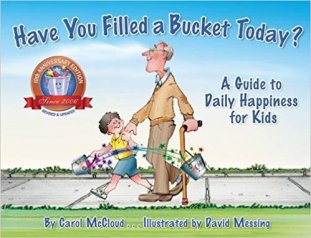 This uplifting book was the winner of 8 Mom’s Choice Awards. It is a great reminder for everyone about the importance of kindness and lifting each other up. I referenced a lot of thoughts and ideas that I had while reading this book during several conversations with educators in school age programs. It made me think about positive group reinforcements for being kind to one another every day. Through conversations with both the educators and children, we came up with an idea to have physical buckets for each child in the program and a big jar of pom poms to put in another child’s bucket when someone noticed them doing something nice for a peer, or just being kind throughout the afternoon. Continue reading
It seems there is a new article or research every week about the adverse effects of screen time on children. Too much screen time has been linked to child obesity, attachment issues, lack of sleep, delay in language acquisition and sensory overload to name just a few.
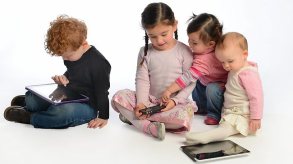
While children are watching TV, using a computer, gaming device, tablet or smartphone, they are missing out on opportunities. Opportunities to make connections with the world around them including forging real relationships with peers and adults in their life; opportunities to problem solve, to be creative, to feel, touch, smell and make sense of their environment. Continue reading


This book is a unique memoir written by Naoki Higashida, a thirteen year old boy with Autism. Naoki is unable to use expressive language to communicate however he has developed the skill of using an alphabet grid to construct sentences. His book allows the reader to enter into his world. He formats the book as a series of questions and answers such as “Why are your facial expressions so limited?” and “Is it true you hate being touched?”. Naoki’s answers are personal; however at times he does use the pronoun “we”. I think it is important for the reader to reflect and not generalize as no two children on the Autism Spectrum are alike. Continue reading
As an educator I found myself frequently volunteering to wash the dishes at the end of the day, it was the perfect stress reducer for me and gave me the opportunity to reflect on my day. Sensory play is not only important for children but for adults too!
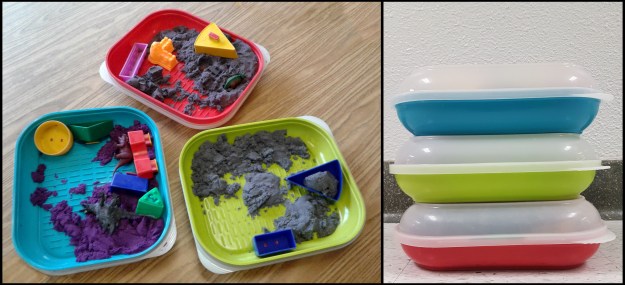
Three personal sensory bins with moon sand to allow children easy access and choice. These bins have lids to allow them to stack for easy storage in an accessible area to promote independence. – Fairview Child Care.
 ACCESS Inclusion Newsletter