
We all know the saying “A picture is worth a thousand words”. For those of us in child care, this can be put to use and proven in many ways. Some programs use real pictures to welcome parents/guardians, children and visitors and to remind them that they belong and are valued members of the community. Others use pictures to introduce new toys and equipment and to provide suggestions of how to use them safely and creatively. Dramatic play can be greatly enhanced when real pictures of children using props and play materials are posted. This provides children with examples of how they can incorporate the use of props to extend their play. Pictures can also be used to enhance the daily log, parent/guardian notice boards as well as providing information regarding staff changes and upcoming events. They can be used to track curriculum planning and to document what the children did during the day at child care or while on an outing offsite. In addition, pictures can be used to help the children recall recent events and past experiences and to build the children’s understanding of their community and their world. Continue reading
Category Archives: Educators / Providers
Behaviour Guidance Tip – Pairing Positive Reinforcement with a Child’s Name
Did you know the impact of pairing positive reinforcement with a child’s name can;
- Provide positive attention
- Enhance self-esteem
- Build self-confidence
- Establish a sense of belonging
Toddler Scenario:
The whole family is sitting at the table for dinner. Charlie is looking at his plate and notices a new food. He pushes his plate away and says; “I don’t want that”. The parent says, “They’re peas, they taste good”. The parent refrains from using Charlie’s name. After Charlie eats the preferred food on his plate, he decides to take a small bite of peas. The parent waits until Charlie tries again and then says with a big smile; “Charlie, you tasted your peas”. Charlie smiles. Continue reading
Creating Engaging Outdoor Spaces for Children
 As a Registered Early Childhood Educator (RECE), I believe that outdoor play is essential to children. I strive to take the children outside on a daily basis throughout the changing seasons. Depending on the weather, it can be challenging to keep the children engaged in play. Here are three strategies that I have found helpful to keep the children involved in their time spent outdoors:
1. Interest-Based Activities – Provide children with activities that are of interest to them. Be attentive to the conversations that are happening in the program to further their play based on their changing interests.
2. Provide open-ended material – Think about the purpose of the materials that are being set out and ensure that the materials can be used in a variety of ways. Providing these open-ended materials allows the children to adapt their play and encourages the use of their imagination.
3. Get involved! – The best way to get children engaged in an activity is to participate with them. I model for the children the different ways in which the materials can be used, encouraging them to play.
WANTED: a Voice and a Friend
 A mother’s story about the challenge of having a child with Childhood Apraxia of Speech
Voiceless….to have no voice. To be unable to effectively tell others how you feel, what you want or what you are thinking…this is how my 8 year old son feels, each and every day. He’s not silent. He tries so very hard to communicate and we listen. We try to understand and respond. Often, he’s not understood. Not even by us, his loving parents who want so much to connect with him. Many times he just gives up or shrugs and says “I don’t know” when asked a question during a conversation. It’s just too hard for him. My son has Childhood Apraxia of Speech (CAS) and his name is Ewan. Continue reading
Dr. Jean Clinton Makes Connections While in Ottawa
On October 3rd, Andrew Fleck Child Care Services along with community partners hosted an event with Dr. Jean Clinton. Dr. Clinton is an Associate Clinical Professor at McMaster University and author of many papers on early childhood development. In her inspiring presentation, Dr._Clinton explored the benefits of positive adult-child relationships, focusing on the importance of connections in a child’s education and development. Along with the growing research on the benefits of play-based learning and mindfulness, Dr. Clinton presented the benefits of an educator’s emotional connection with each child.
Dr. Clinton discussed the role of relationships in child development starting from birth. The first relationships which are typically between a mother and her baby create the internal representation of how children expect others to treat them. The level of attachment will affect a child’s relationships, academics, self-regulation and resilience. Experiences, connections and stressors change how babies and children respond to the world. Dr. Clinton emphasized that it is our responsibility as a community to support the positive attachments of mothers and babies. This relationship will virtually affect all other aspects of their development. Continue reading
Fostering Connectedness in your Centre
The Children’s Village at Bridlewood is one of four licensed school age programs operated by the long standing and respected Children’s Village of Ottawa-Carleton. I am the program supervisor and I get to experience the best of both worlds by splitting my time in both the office and on the floor as a team teacher. Our agency takes pride in its programs, the fostering of connectedness between staff, parents, colleagues and most importantly the children. We also value the overall impact of connectedness on learning and behaviour.
A colleague of mine recently brought to my attention a discussion she had with one of our children, a seven year old boy. He had counted the hours he was at school in a day and compared it to how many hours he spent at home with his family. “Miss, did you know I’m at school for ten hours? That is more time than I am with my family and more time than I am asleep”. Educators and operators of before and after-school programs know this realization all too well. For me, working under the motto “It Takes a Village to Raise a Child” means we aren’t just educators, we are a family away from home to these children.

The Children’s Village at Bridlewood 2014-2015
It All Starts with Strong Relationships
Scenario 1 – Steven arrives with his grandfather and they are warmly greeted by an Educator. Steven joins the children playing Octopus. He often needs help remembering to follow the rules and routines and has a really hard time being “out”. When he gets “out”, he becomes really upset. When this happens, the Educator calls him over and gives him a strong hug to activate his listening ability. Without the hug, he cannot hear what is being said to him. His feelings are acknowledged by saying, ” You didn’t want to be out. It’s hard to be out. A new game will start soon. Do you want to wait here or with the other children who are out?” Steven moves to join the other children. A simple hug and an acknowledgement of his feelings really helps him turn things around. Continue reading
Using Letter Links in a Preschool Program
As parents, we agonize over the selection of a name for our new baby. The sense of personal identity and uniqueness that a name gives is at the heart of why names are so important.
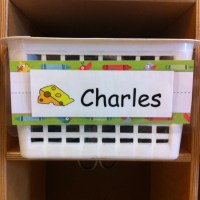 Letter links are the pairing of a picture with a word that starts with the same letter and sound. Considering that children are naturally attached to and familiar with their own names, it makes perfect sense to begin literacy knowledge here. For example, Kevin might have a picture of a king and Sarah, a strawberry. In choosing the picture for a child’s letter link, remember to match the starting sound, as well as the letter. For example, Isaac could have a picture of ice cream, but an igloo image would not be appropriate (long versus short /i/). Names beginning with double consonant sounds should be considered too; Trevor could be tree, etc. Continue reading
The Jar of Joy
 As a way of acknowledging acts of kindness, one child care program uses pompoms. That’s right… pompoms and a Jar of Joy!
First the educator explains the concept of random acts of kindness and introduces the pompoms and the Jar of Joy. Then the group talks about what kinds of things each child could do to receive a pompom to put in the Jar of Joy. They also discuss what fun activities they could do as a group once the Jar of Joy was full. Then the fun begins! Continue reading
A Home Away from Home: the Infant and Toddler Programs at Elizabeth Park Child Care Centre
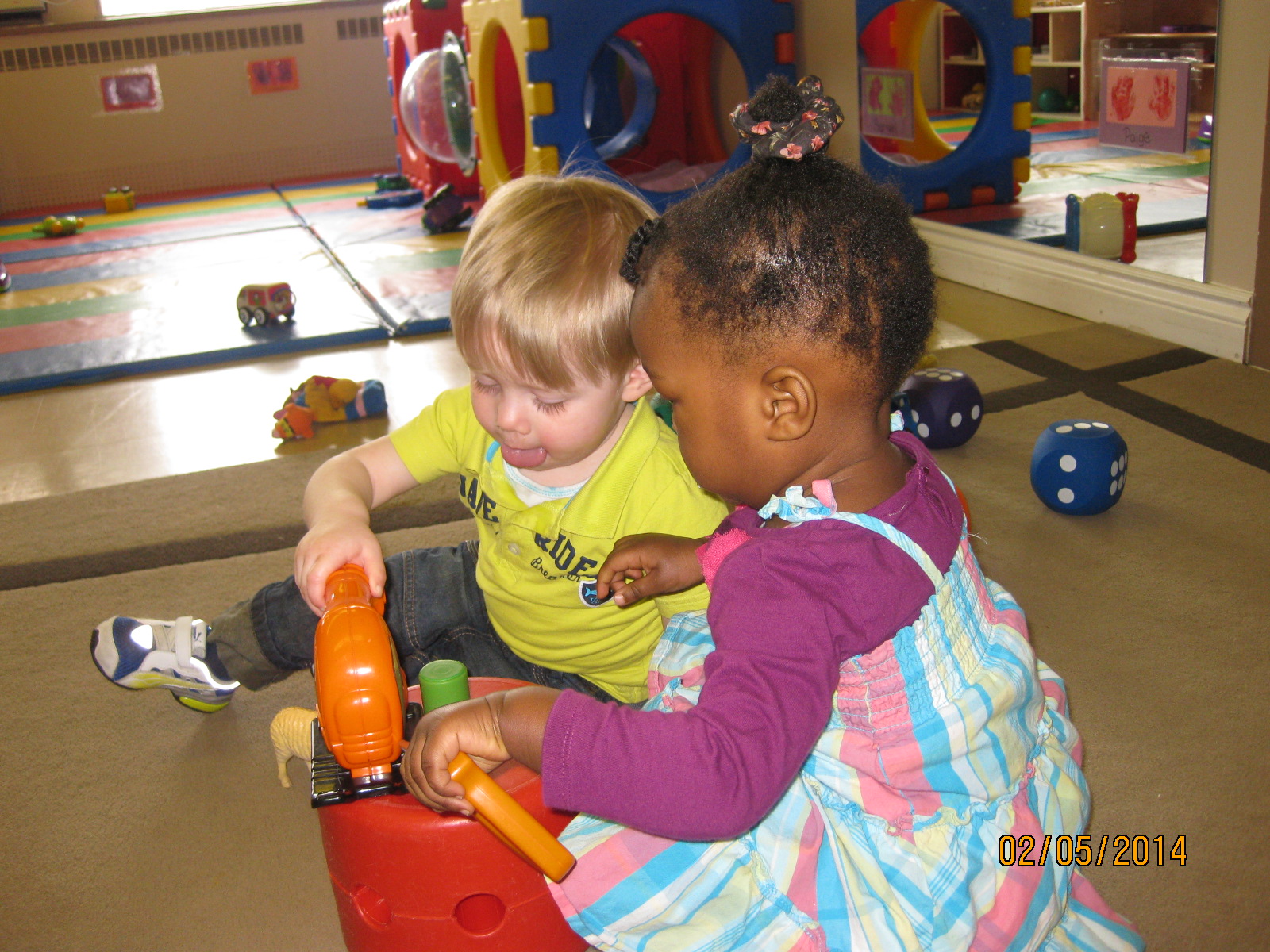 Elizabeth Park Child Care Centre is one of seven child care centres operated by Global Child Care Services. We serve infants, toddlers and preschoolers, and are located in a renovated wing of the Uplands Catholic Elementary School on the CFB Uplands military base. We are surrounded by many playgrounds, walking trails and a water park.
Our Infant and Toddler Programs have been in operation since 1987. These programs are the first stepping stone on a long journey for the children, their families and the staff providing care.
The staff at Elizabeth Park Child Care Centre work hard to create a “home away from home” environment where all families and children feel welcomed and safe. The first initial phone call to parents starts the journey, by providing important information about our programs, and extending an invitation for families to come and visit our centre. Continue reading
 ACCESS Inclusion Newsletter