
One of the most important skills you can help your child develop is the ability to deal with change. There are everyday changes all children face, such as adjusting to a new caregiver or school, or to new teachers and friends. Many children must face bigger changes as well following a loss, a move, or a divorce in the family. All change, whether it’s the end of the school year, the birth of a sibling, or a move to a new home, brings some sadness and uncertainty, as well as anticipation and excitement. You can help your child develop the skills to handle change by understanding your child’s needs and by offering encouragement and support. Continue reading
Author Archives: cissnewsletter
The Key to Happiness
We are all together in that we want to be happy and appreciate that every moment is a gift; to find a balance in our lives. Give yourself some time to reflect on holding the key to happiness in your own hands. Listen to other accounts on how surrounding yourself with people that make you feel good and how meaningful relationships are protective and help you move forward. Think about building resiliency in your life by investing your time and energy into relationships and connections with others and yourself. Be inspired and rethink your approach to stress by seeing it as encouragement to rise to the challenge! Continue reading
Time Saver, Cost Saver, Super-Sized Fun Activities
Are you looking for activities that will save you time and money but that are big on fun and learning? Let us introduce 2 more activities from our featured series. All materials for the activities can be found at home or purchased in dollar stores.
#11 Bottles and Jars
Objective:
Using simple objects such as plastic bottles and jars to support teaching in many different areas of development. Continue reading
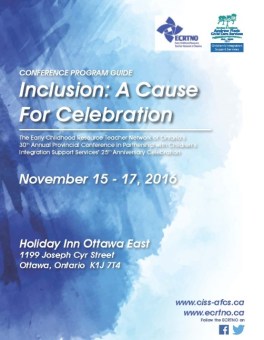
Register Now for the Inclusion: A Cause for Celebration Conference
Attention all Resource Teachers/Resource Consultants, the Early Childhood Resource Teachers Network of Ontario (ECRTNO) and Children’s Integration Support Services (CISS), a program of Andrew Fleck Child Care Services, are pleased to invite you to attend our celebratory conference Inclusion – A Cause for Celebration on November 15, 16 and 17th, 2016. The conference marks the 30th anniversary of the ECRTNO as well as the 25th anniversary of CISS.
Please check out our conference program guide for the complete lineup of keynotes, workshops, the registration information and more.
Fostering Social and Emotional Growth through Amigos Club
Educators have numerous responsibilities to the children in our care. Most importantly we are responsible for fostering their social, emotional, cognitive, and physical development. In our school age program for children aged 6 to 8, we set goals for creating new friendships between peers and fostering skills to support basic social interactions (e.g. asking to join a game already in progress). But where to start?
Our CISS Resource Consultant told us about a former program called “Amigos Time”. It sounded exactly like what we were looking for. The concept is fairly simple. Each week, the educators place the children in pairs. The pairings are written on a dry erase poster hanging on our Amigos Club bulletin board, and the children are very excited to see who their partner will be upon arrival from school on Mondays. Each educator introduces a cooperative activity once or twice a week that they do together. Continue reading
Supporting Immigrant and Refugee Children and Families
The document How Does Learning Happen? Ontario’s Pedagogy for the Early Years stresses the importance of Registered Early Childhood Educators (RECE’s) engaging in a strong and respectful relationship with children and their families in order to foster a sense of belonging.
In February 2016, Judith Colbert PhD was the keynote speaker at the Welcoming Newcomer Children Conference who spoke about meeting and responding to the needs of young immigrants and refugees. Judith shared that young newcomers have distinctive needs arising from their settlement experience which may differ from other children in child care programs. Continue reading
Behaviour Guidance Tip – Preparing Children for Transitions
Did you know that preparing children for upcoming transitions saves time, energy and reduces challenging behaviours from occurring?
Examples of transitions include:
- Getting ready to leave home to go to child care or child care to go home.
- Leaving play for lunch.
- From outdoor play to indoors.
- Getting ready for sleep time including nap and night.
By planning and organizing your transitions, it creates a plan that can be implemented by anyone. Continue reading
Where Are They Now?: Rebecca’s Journey (Updated)
 Previously published in the Spring-Summer 2006 issue of ACCESS Integration.
Rebecca, born on February 1st , 1990, has Down Syndrome and lives with her mother, father and older sister, Monika.
Rebecca has been integrated into regular child care settings since she started day care at the age of two and a half at Dow’s Lake Day Care. It was there that support from Children’s Integration Support Services began.
Rebecca started her school years at St. Patrick’s Elementary School and attended the Barrhaven Child Care Centre school age program. When she first started at the day care, integration was a new concept and a “learn as you go” approach was taken by Rebecca’s family and teaching team. Rebecca’s parents were very appreciative of the team that was assembled to help and for the ongoing support of their Resource Consultant. Continue reading
Summer is for Play
Summer is coming! As you are planning for your summer, consider some new and exciting activities or variations of old favorites for your outdoor play spaces.
The following websites provide an inclusive and inspiring approach to promoting physical activity in programs and at home. Continue reading
Children with Multiple Handicaps
Throughout Canada, changes are being made to facilitate and provide a positive inclusion experience for all children with special needs. In our society, it’s important that we emphasize the dignity and value of each child. The myth that only “some” children can be included is false, all children can be included with the proper community support. The key to a successful inclusion experience is team work and communication. We need to remember that the parents\guardians are such a vital part of our team.
Here are some strategies that I’ve used as a preschool teacher.
Basic guidelines:
- Project a positive attitude when working with the children. Optimism is catchy.
- Be flexible, be prepared to make changes, adaptation to the program and/or toys to ensure a positive inclusion experience.
- Consult with the parents\guardians, your Resource Consultant and therapists about the different methods of carrying and positioning their child.
 ACCESS Inclusion Newsletter